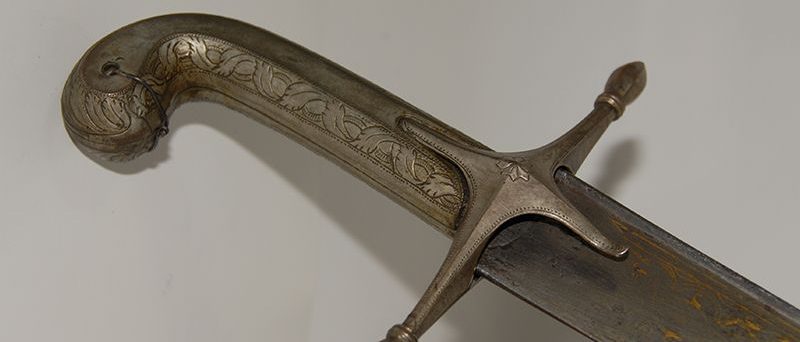
The most important part of the Museum collection “Weapons and military equipment” includes cold and firearms from the First and the Second Serbian Uprising. Items belonging to the Military Museum and the Historical Museum of Serbia are displayed as a part of the permanent exhibition in Takovo. When taking into consideration the fact that these are all craftwork, then each of them possesses both historical and artistic value. Craftsmen, such as jewellers in the first place, seemed to be competing in decorating all parts of the weapons by applying all the known techniques of the time (filigree, granulation, engraving, stamping, damascening…).
The most famous oriental weapons are yatagans and sabres. Yatagan is a long sword with a curved blade, which represented a formidable weapon in combats. Visitors of the museum in Takovo have the opportunity to see two types of yatagan: with a white hilt (made of ivory) and a black hilt (made of wood). Yatagan blade was made of the highest-quality steel and was lavishly decorated with floral ornaments or Arabian inscriptions on both sides.

Sabre is a cold weapon used for attack and convenient for a combat during the charge. The only specimen available to our public is a sabre from the 18th century, which is displayed in Takovo and is owned by the Military Museum (Inv. No. 12595). The sabre is 83 cm long and it has a hilt in the shape of a gun, decorated with cast relief. The quillon is straight, its ends being decorated with two buttons in the shape of an acorn. The blade is 70 cm long and 4.5 cm wide, with a kilij-type curve of 14.5 cm. Ottoman sabre or kilij is a single-edged blade, straight almost to its middle part, after which it gradually becomes wider towards the tip of the blade thus making the blade in that part of the same width as in the handle part. Floral motif is engraved on the blade, as well as a gold stamped six-pointed star, which the Turks call the Seal of Solomon.