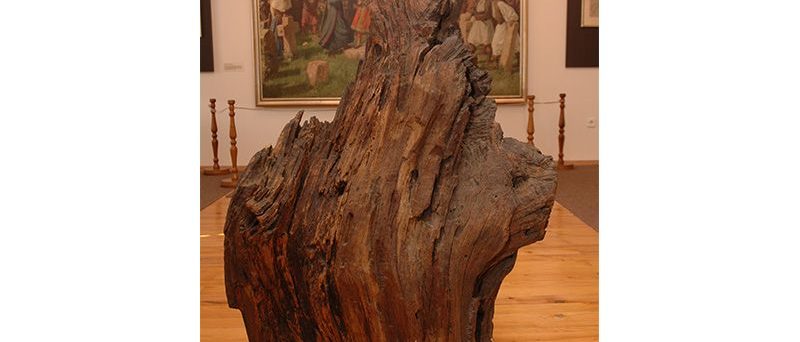
The central part of the museum exhibition in Takovo, besides Paja Jovanović’s painting, is another slightly unusual exhibit. That “natural monument” of its own kind, which is about one metre in height, nowadays represents a symbol of Serbian freedom and independence. With this in mind, it is easy to come to a conclusion that it is notable Takovo oak tree, better known as bush among general population. Even though time has made it small and old, it is still capable of telling the story about a leviathan who has become a part of our history forever. Numerous wild oaks have always been characteristics of the valley of the rivers Dičina and Ljeskovica. Among them, there was one one-hundred-year-old pedunculate oak, under the shade of which Miloš started a struggle for freedom. It left a strong impression on its beholder with its 23 metres in height and five big branches, as well as its diameter of 3.5 metres. The bush gradually started deteriorating owing to its circumference of almost 9 metres.
According to the record of General Jovan Mišković, in the 1860s a big crack appeared at the base of the tree, which children used as a place to play. Three out of five branches had already fallen off. The Obrenović family treated Takovo bush with a special attention, as they considered it their dynasty’s relic. The fact that proved this right was the data that the first Serbian modern order was named after it. On the other hand, folk culture has its own “interpretation” of this connection as well. According to it, whenever a branch fell off the Takovo bush, some bad things happened to the Obrenović family: Miloš’s death, the murder of Prince Mihailo, King Milan’s abdication… Finally, a storm would destroy the remnants of the oak tree in June 1901, which served as an ominous “prediction” of the May catastrophe that struck the youngest Serbian dynasty.
Having been given as a present to the Museum by the church in Gornji Milanovac back in 1994, the remnant of the Takovo bush deserves the attention of the wider public without doubt.
This is a low-rise building with a spacious attic and lavish staircase that lead to it. Besides, the interior includes a central room which stands out with a fireplace in its left corner, then another big room, two smaller ones, a kitchen and a basement. What makes the interior of “the family Brković house” so special are arched passages that connect all the rooms, as well as its striking exterior with a big gable roof, which has two windows and which covers the entrance door, thus making some sort of entrance hall. Owing to its charming appearance and functionality, it was extremely suitable for the Museum of Rudnik and Takovo Region, which was officialy opened there in 1994.