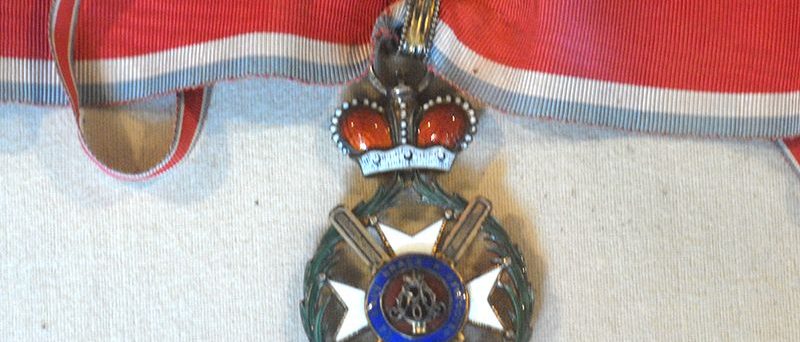
The Museum of Rudnik and Takovo Region’s collection of insignia encompasses orders, medals and commemorative medals from different time periods. The most significant one is definitely the first national order – The Cross of Takovo. It was established in 1865 on the occasion of the celebration of the fiftieth anniversary of the Second Serbian Uprising. Mihailo Obrenović awarded the Cross of Takovo to the survivors in memory of prince Miloš and insurgents, whereas the families of the killed would get a Commemorative medal.
The visitors of the museum in Takovo have the opportunity to see The Order of the Cross of Takovo, 3rd class, The Order of the Cross of Takovo, 4th class (the property of Nebojša Smiljanić from Takovo), as well as a Commemorative medal of the 50th anniversary of the Second Serbian Uprising (the property of Mihailo Jovičić from Gornji Milanovac).

The basic part of the medal consists of a white enamelled eight-pointed cross placed together with Saint Andrew’s cross (a part of the most significant Russian order). In the very centre, there is the prince’s monogram “MO III” with the crown and the inscription “for the faith in prince and the homeland”. On the reverse, there is the coat of arms of the Principality of Serbia. Third class order is entirely entwined by a green enamelled wreath, whereas fourth class order has the same wreath, but only in its central part. Higher class order was worn around the neck, on a red ribbon made of reps with a blue and a white stripe along its edge, while the lower-class order was worn on the chest.
The appearance and purpose of the order were both finally defined during the rule of King Milan. The Order of the Cross of Takovo, which was given for war merits, got two horizontally placed swords between the order itself and the crown in 1883, whereas the peacetime one remained the same. This initially war only medal was awarded on a massive scale in the last decade of the 19th century, and it stopped being used completely with the death of the last member of the Obrenović family in 1903.
This is a low-rise building with a spacious attic and lavish staircase that lead to it. Besides, the interior includes a central room which stands out with a fireplace in its left corner, then another big room, two smaller ones, a kitchen and a basement. What makes the interior of “the family Brković’s house” so special are arched passages that connect all the rooms, as well as its striking exterior with a big gable roof, which has two windows and which covers the entrance door, thus making some sort of entrance hall. Owing to its charming appearance and functionality, it was extremely suitable for the Museum of Rudnik and Takovo Region, which was officially opened here in 1994.