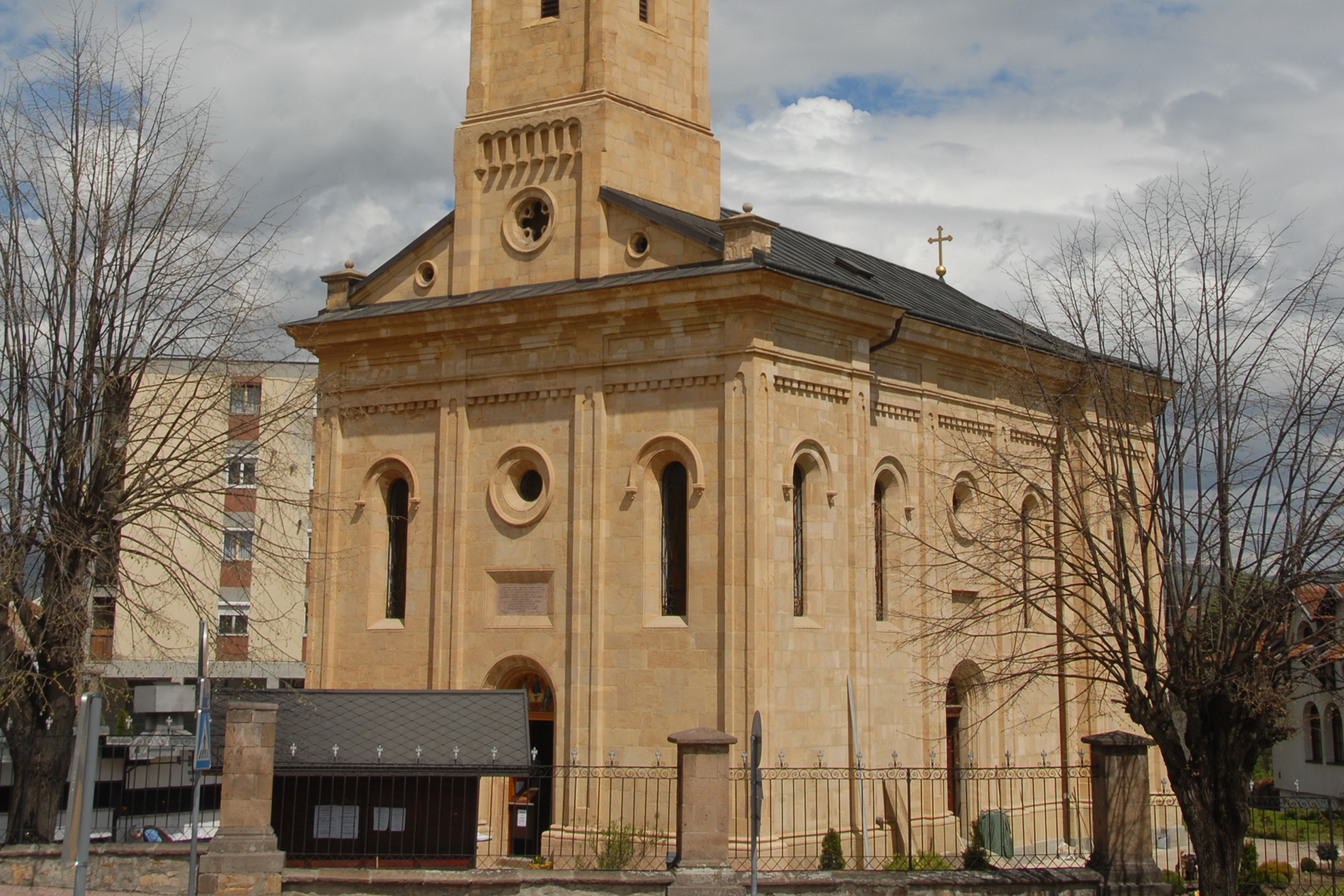
Prince Miloš Obrenović dedicated final years of his life to building a church in Gornji Milanovac which would become one of his most important endowments. When he passed away, it was his son prince Mihailo who carried out the final construction works on the temple by building a Baroque bell tower on its west side. A renowned builder Nastas Đorđević from Ohrid – the founder of a famous family Nastasijević – finished the church in 1862. Basic data about the building of the temple which is carved as the founder’s inscription in the stone parapet above the entrance of the church says that the church is dedicated to the Holy Trinity and that it was erected by Serbian prince Miloš to commemorate his brother duke Milan Obrenović. According to a folk tale, there used to be a log cabin church dedicated to Saint Toma at the exact same place where the present-day church is built.
Designed in a classical style, the Holy Trinity church is marked as the most famous and stylistically purest monument of the epoch despite the fact that the repeated design of the church, which prince Miloš built in Topčider – with a frieze and a bell tower at the west end – testifies clearly about the clash of two epochs. The temple has a longitudinal foundation with a semicircular apse at the east end and slightly protuberant space for the choir. The interior of the church is simple with a semicircular vault. The space for the choir is above the entrance itself, and a narrow stone staircase leads to the bell tower. Nicely cut stone blocks of specific ochre colour sandstone from Takovo were used as a building material. They were obtained from a mine in Sinoševići following the wish of prince Miloš. The exterior of the temple is decorated with arcades, pilasters, arches, consoles, rosettes… Besides the main portal, the church has two side ones as well, and semicircular windows. The bell tower has openings on all four sides with clocks above them, which give it the role of a clock tower. The money for the clock mechanism was donated by an army general Božidar Terzić to commemorate his mother, Jerina.
Upon finalising the construction works, the church got its iconostasis, the work of art of Nikola Marković, who unfortunately died during the burning down of the town in 1941 when the east part of the church was demolished.