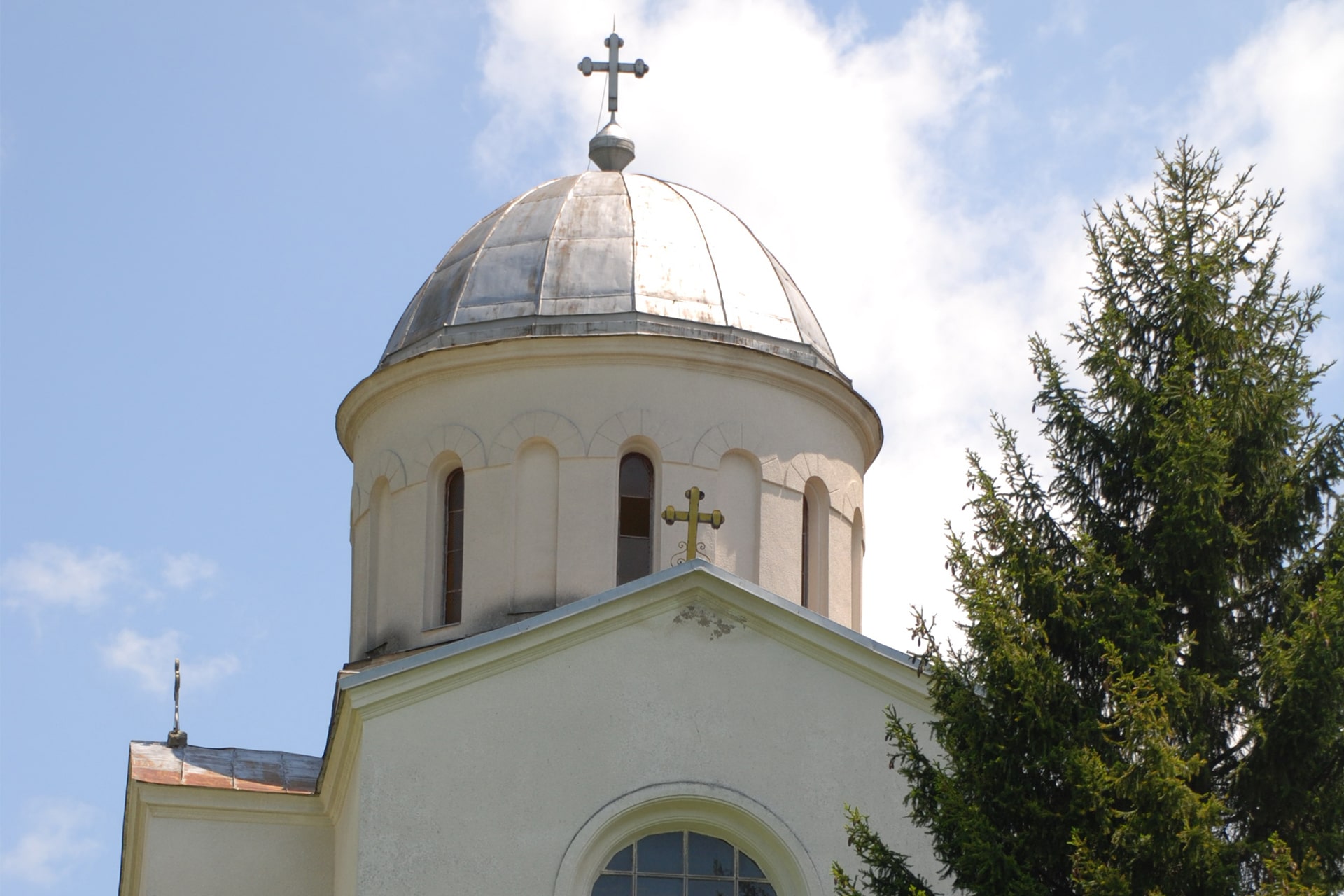

In the vicinity of the present-day church in Majdan, there used to be a log-cabin church, which was torn down in 1813, probably following the failure of the First Serbian Uprising. Shortly after, the priest Sava Popović built a new temple, according to the inscription on the southwest façade made by his descendant who built the present-day church. During the Second Serbian Uprising, while going towards Čačak, Ćaja Pasha passed through Majdan before the Battle of Ljubić in 1815 and burned a log-cabin, so it is assumed that it was the aforementioned church built by Sava Popović.
The Holy Trinity Church is located in the centre of the settlement, in an area known as Rijeka, in the vicinity of which there is a school and a cooperative union. It was built owing to the effort of a priest – Sreten Popović – who was born in this village, as well as the financial help of King Alexander Obrenović. There is an inscription above the entrance door testifying about his generosity: “In 1891, His Royal Highness King Alexander I gave 600 dinars for the building of the Holy Trinity Temple for the eternal memory of his reign”. According to the data taken from the church’s chronicle, episcope Sava Barać Dečanac consecrated the church in 1891. It was built in Serbian-Byzantine style in the shape of a cross with a sophisticated dome at the intersection of naves, which gives the temple an impressive appearance. The complete archive of the church in Majdan was burnt in the First World War, so the names of architects and builders have remained unknown. Judging by the work they conducted, they must have been well educated, and the only thing known is that the person who painted the icon in Majdan was a painter from Macedonia, Nastas Tomić (1845-1900).
With the change of the Dynasties, and the Karađorđević becoming the ruling family in 1903, a massive simple bell tower was built north to the church with the inscription which remained unfinished for unknown reasons: “This bell tower was built in 1903 during the rule of Serbian king Peter I Karađorđević and the episcope of Žiča Sava Dečanac, as well as priest Sreten Popović. And…”.