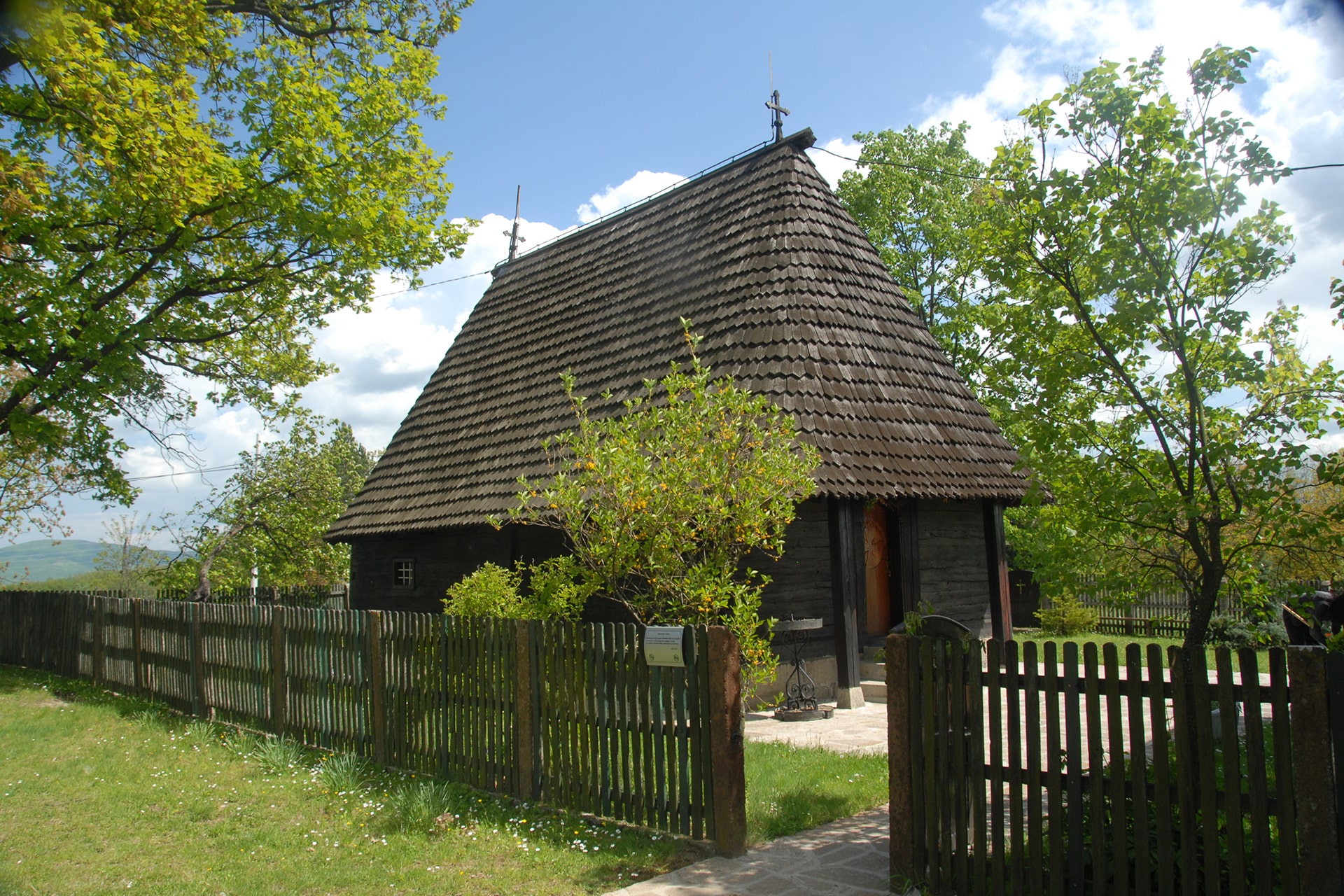
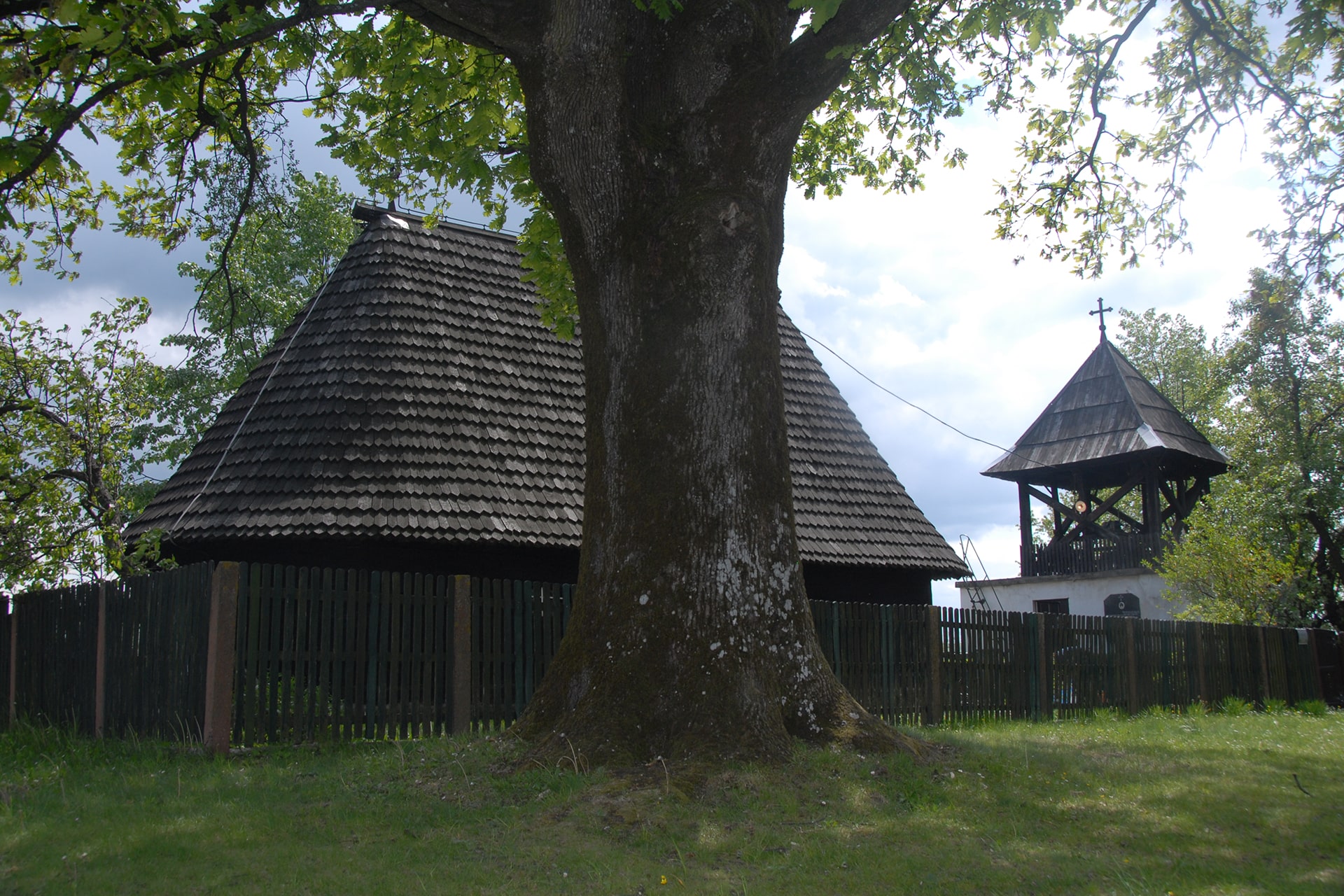
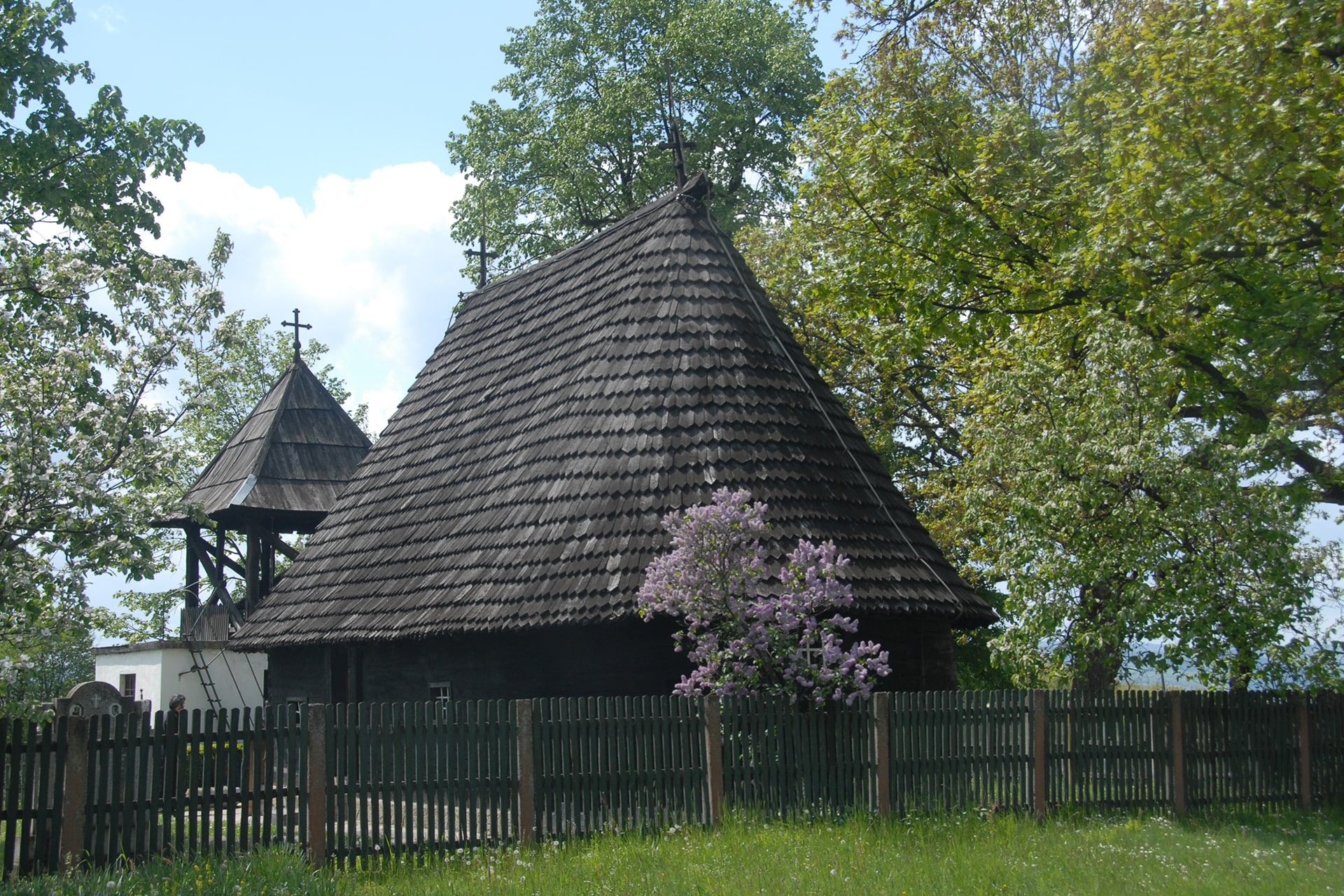
About a mile away from what used to be a train station and in the near vicinity of a school in the village of Ljutovnica, on a hill that oak tree forest used to cover, there is a log-cabin church. It is dedicated to the “summer” feast of Saint Nicholas (the transfer of Saint Nicholas’ relics), with the previous patron saint of the temple being Archangel Michael. The church was built in 1809, as it was written down in a bright colour above the main portal. According to the Chronicle of Ljutovnica church, much credit for its building goes to the priest Jovan Vulinović Tomić, whose grave can be found in the churchyard.
The building underneath the roof consists of a semi-circular altar space and the main part of the church, which used to be divided into a nave and a narthex, but now is whole. The church has the stone foundation and massive planks with dovetail joints to the northwest and the southwest corners, whereas the east semi-circular part of the temple has planks with a scarf joint. A similar building pattern, approximately the same measures, as well as the interior and the exterior, all point out the fact that builders took a temple in Takovo as their model. There is a possibility that some of the workers, who had already built facilities in Takovo region, also built this temple in Ljutovnica. Eaves that lean on two pillars on the west side prove once again that the talented builders had a task given to them beforehand – to re-build the church which had a great influence on the tradition of the people of this region. They even repeated the ornamental details, the lintel, the doorpost, as well as the north and the west doors. Both building and decorative elements prove that builders came from Osat, but their names have remained unknown. However, it was written that “the wedges for this church were made by Petronije Milić, a gipsy from Mekot in Takovo”.
The iconostasis from the time when the church was built – to be more precise, it was made a year later – is a work of art made by Nikola Apostolović, a painter from Zemun. The upper medallion of the Holy door contains the name of master Nikola Muzikravić, who donated it to the church in 1810. An extremely valuable liturgical book – The Triodion from 1622, which was written in Studenica – is kept inside the church in Ljutovnica.