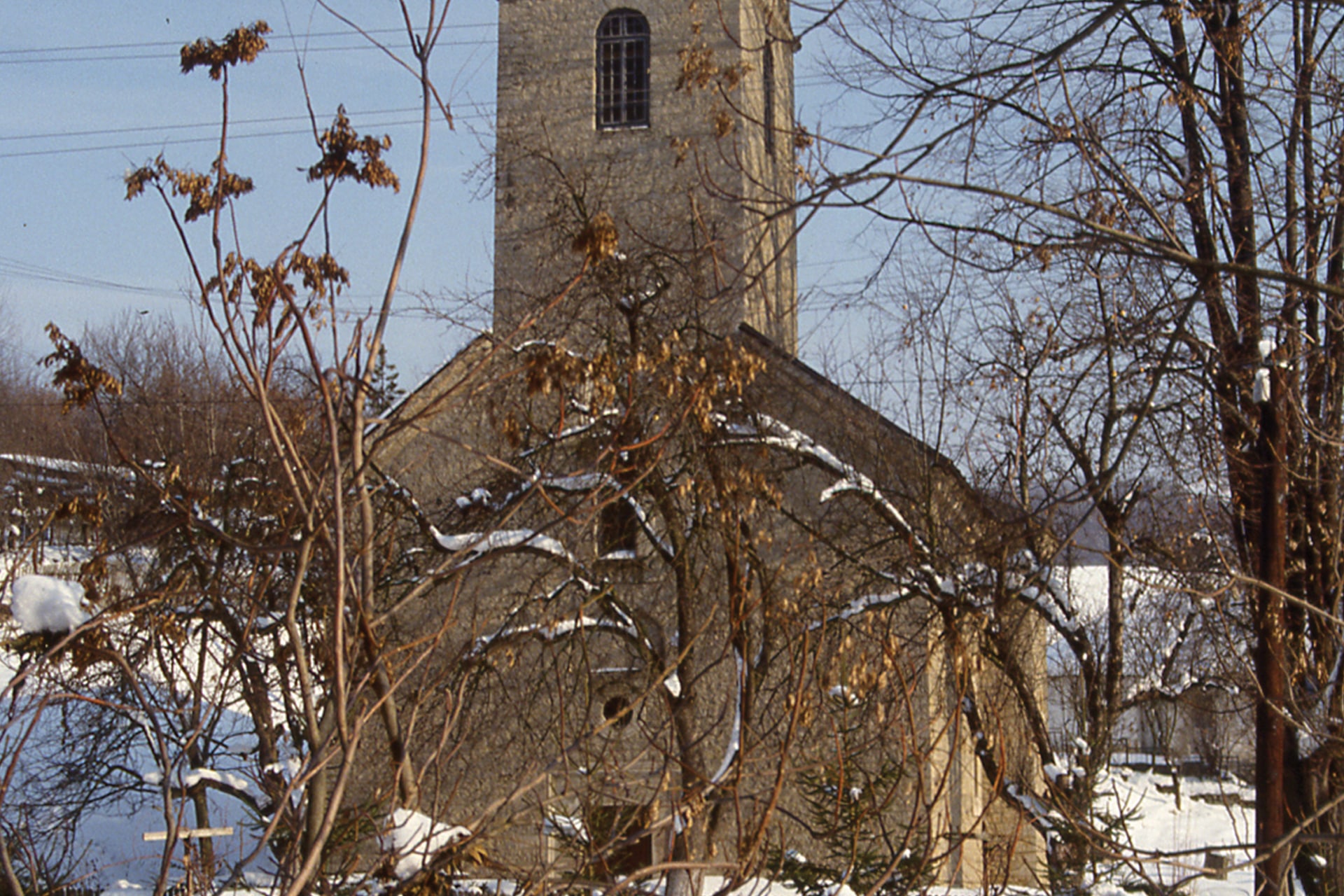
Saint Nicholas’ church in Boljkovci, which was built from 1838 to 1843, represents one of the oldest parish churches in the municipality. It is dedicated to the feast day of the Transfer of the relics of Saint Nicholas. Since it contains Romanesque elements in architecture, which are skillfully combined with a Baroque bell tower from the latter period, it almost completely clashes with other churches of Rudnik and Takovo region in architectural sense. Its builder is unknown, and it was constructed at the place where there used to be a log-cabin church with parishioners’ contributions.
The temple is a single nave church. However, the two side ambons, which are placed symmetrically on the north and the south side, make the exterior of the church look like a cross. Besides, a big semi-circular east apse, which has two smaller side apses on its exterior part, gives the impression of the church being triconch. The interior should contain a diaconicon and a prothesis, but instead of that, those are two barely noticeable rooms to the left and the right of the altar. The church has an arched shaped ceiling supported by pilasters and retaining arches, and what is interesting is the appearance of a cross-like vault at the centre of the bell tower. Dressed stone was used for its construction – from the foundation to the roof – and the walls are extremely massive, up to one and a half metre in width even. The bell tower with a Baroque dome, which was added in 1864, dominates the building and emphasises its verticalism, whereas the front façade has an interesting architectural design. Above the entrance part, there is a small rosette, i.e. a round window with a lunette above it, containing the image of Saint Nicholas – the patron saint of the temple. There is an unusual composition with lions and masks on a stone plate atop, above which one can see a bricked-up window with an arch on top. Besides the main one, the church also has a side north entrance with decorated doorposts, and inside the stone lunette there is a flower-like ornament. A nicely carved wooden iconostasis encloses almost the entire altar space and it has a traditional arrangement of the icons. It is not the original one; it was replaced in 1907. Icons were made by a painter who wasn’t widely known – Marković – following the example of Uroš Predić.