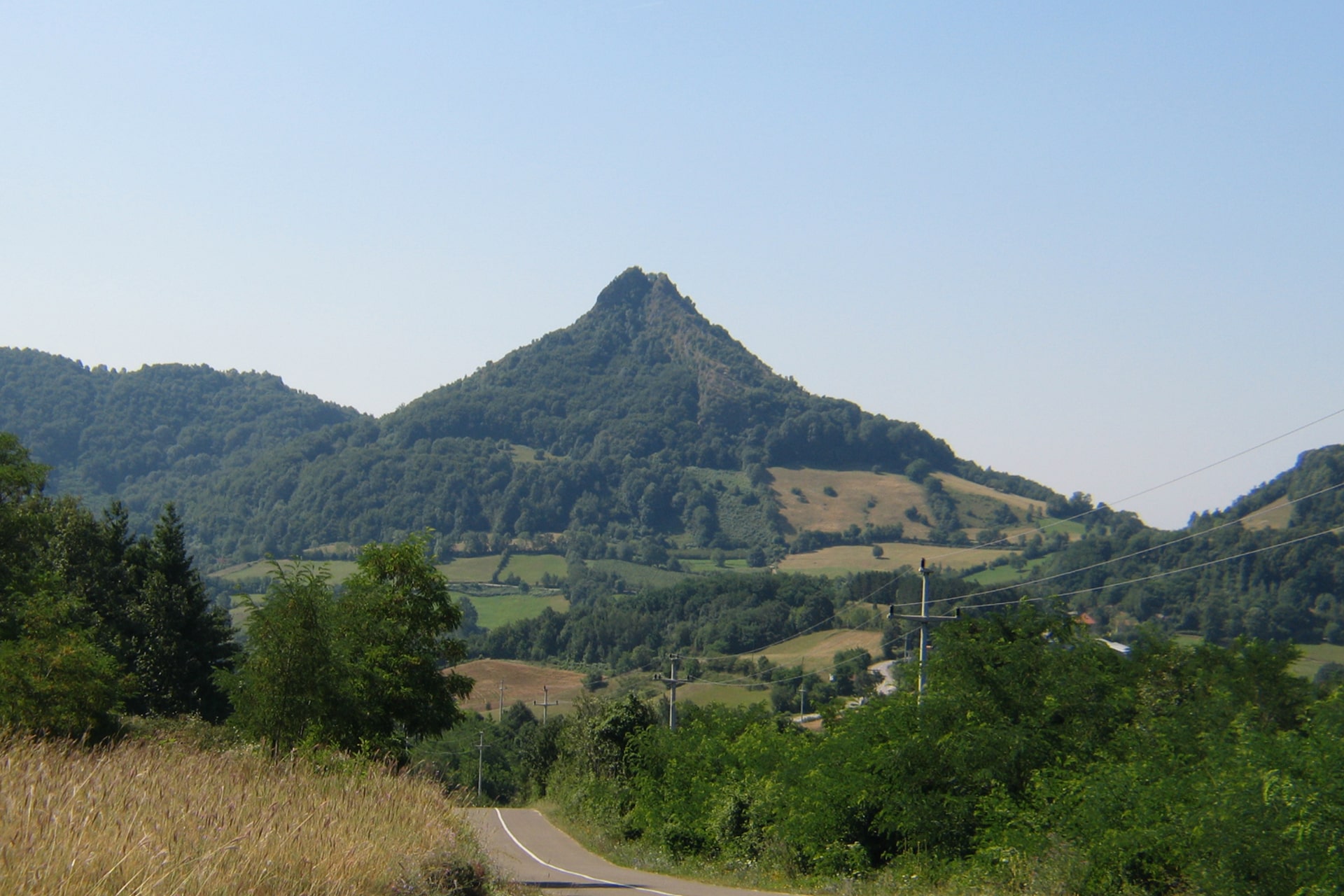
Ostrvica represents a rare relief phenomenon, due to both its unusual shape and impressive size, as well as the way it was created. It has an elevation of 758 metres and it is located 6 kilometres away from the Rudnik mountain to the North-West. When taking the geological point of view into consideration, Ostrvica consists of volcanic rocks formed following an eruption which belong to the group of andesite rocks.
Nowadays, Ostrvica belongs to the group of extinguished volcanoes, one of many which were active in the geological history in the volcanic region of Rudnik. The estimated age of these rocks is about 18-20 million years. Two rounded peaks with height difference of 4 metres together make small and big Ostrvica. One can still see the remains of the town on them. It is not known when the town was built even though it was mentioned for the first time in the fifth century AD, but it is assumed that it dates back to the ancient times.
According to historical data, merchants from Dubrovnik and miners from Rudnik came to the town during the dynasty struggles between Stefan Dečanski and Vladislav II, following the demise of King Milutin. Around 1430, despot Đurađ Branković established Ostrvica as a line of defense again against the Turkish invasion. There is a folk tale that it was built by his wife “Prokleta Jerina” (the Damned Jerina), hence its name Jerina’s town.
The Turks conquered and destroyed Ostrvica many times. It was demolished for the first time by Murat II in 1438, then for the second time by Mehmed II the Conqueror in 1454, and for the third time, in the unknown year of the XVI century, it was demolished by the sanjak-bey (prim.prev. a high-ranked administrative officer in the Ottoman Empire) of Smederevo because of the riot of the locals. In translated Turkish scrolls from the XV and XVI century, Ostrvica is mentioned as the base of nahija and kadiluk (prim.prev. administrative units of the Ottoman Empire), under the name Sivridže Hisar. A famous Turkish travel writer Evliya Çelebi visited Ostrvica in 1664 and noted down that the established town and its surroundings were demolished and desolate.
Its unusual volcanic cone with the town on its top, rich history, stunning surroundings and varied endemic mountain flora – where yellow iris and a relic type of shrub Holly especially stand out – are ideal for all nature lovers, such as tourists and hikers (http://www.rudnik.in.rs/rudnik/ostrvica.html). Ostrvica was declared a natural monument towards the end of May 2009.