The court in Takovo – which was built owing to “the people’s statute labour” within less than two years – was given to the last members of the Obrenović family on Mala Gospojina in 1901. Svetozar Šurdilović, who was a prefect of Rudnik district at the time, was “the main initiator” of this because he had hoped to gain reputation and enjoy special privileges with the royal couple and their nearest social environment. Tragic events that were soon to follow would not only cause the disappearance of the notable dynasty, but also determine the faith of the country house built close to the renowned Miloš’s bush to a large extent.
A three-storey building with a “Swiss-like” exterior and “Šumadija-like” interior was left abandoned in a very short while and it started deteriorating. As expected, the entire household of about 2,500 (still usable) objects was now the property of both institutions as well as individuals, whether in a legal or illegal way. Forgotten and barren, the court received a final blow during World War I when it was wiped off the face of the earth in a fire, and everything came to its end in the next great war in 1943.

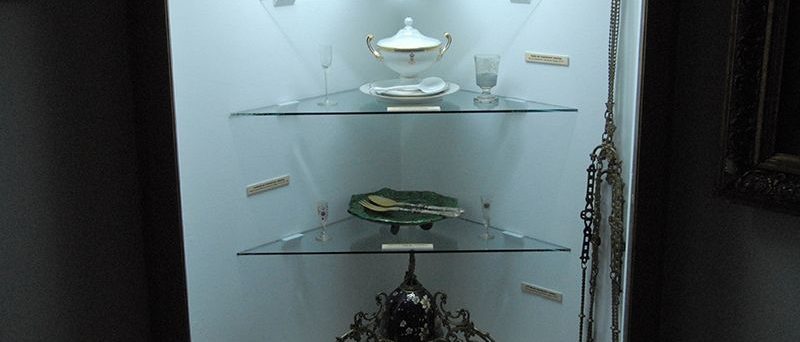
Even though it was founded just two decades ago, our museum has managed to take hold of certain items which are confirmed to have been part of the inventory of Takovo court. It includes 14 objects which have a special place in the permanent exhibition in Gornji Milanovac. Without doubt, a part of lavishly decorated table set made of silver and box shrub, then porcelain plates with Aleksandar Obrenović’s monogram, a round fruit bowl with floral ornaments, and four highly sophisticated glasses draw attention of numerous visitors of 7 Sinđelićeva Street.
Simultaneously, a massive wooden chair with a leather back and arm rest, then a carved and decorated chest with a lid, as well as a luxurious multipiece brass chandelier with a central cobalt “shallow” piece all contribute to the story of the country house, which had never had the glow as expected during the time of its building, due to a concatenation of circumstances…